
Medically reviewed by the clinical team at Bin Haider Healthcare Center (BHHC), a DHA-licensed dermatology and aesthetic facility in Barsha Heights, Dubai operating under Dr. Hessa Bin Haider’s medical supervision, with 20+ years of combined clinical experience and 4.9/5 across 312 Google reviews.
Excessive underarm sweating is a genuine medical condition, not simply a hygiene inconvenience, and Botox was FDA-approved to treat it over two decades ago. Yet many patients still don’t realize this is an established, extensively studied medical indication rather than an off-label cosmetic use. Understanding Botox for excessive sweating means understanding both the underlying condition, called hyperhidrosis, and what the clinical trial data actually shows about its effectiveness. This guide covers the diagnosis, the mechanism, the published evidence, and what to expect at a DHA-licensed facility offering this hyperhidrosis treatment.
What Is Hyperhidrosis, and How Does Botox Treat It?
Understanding Botox for excessive sweating starts with understanding hyperhidrosis itself as a distinct, diagnosable medical condition.
Primary Axillary Hyperhidrosis Defined
Primary axillary hyperhidrosis refers to excessive underarm sweating that goes well beyond what’s needed for normal temperature regulation. It’s assessed clinically using the Hyperhidrosis Disease Severity Scale (HDSS), a 4-point scale ranging from “underarm sweating is never noticeable” to “underarm sweating is intolerable and always interferes with daily activities.” Patients scoring 3 or 4 on this scale are generally considered candidates for medical treatment.
The Mechanism: Blocking the Signal, Not the Gland
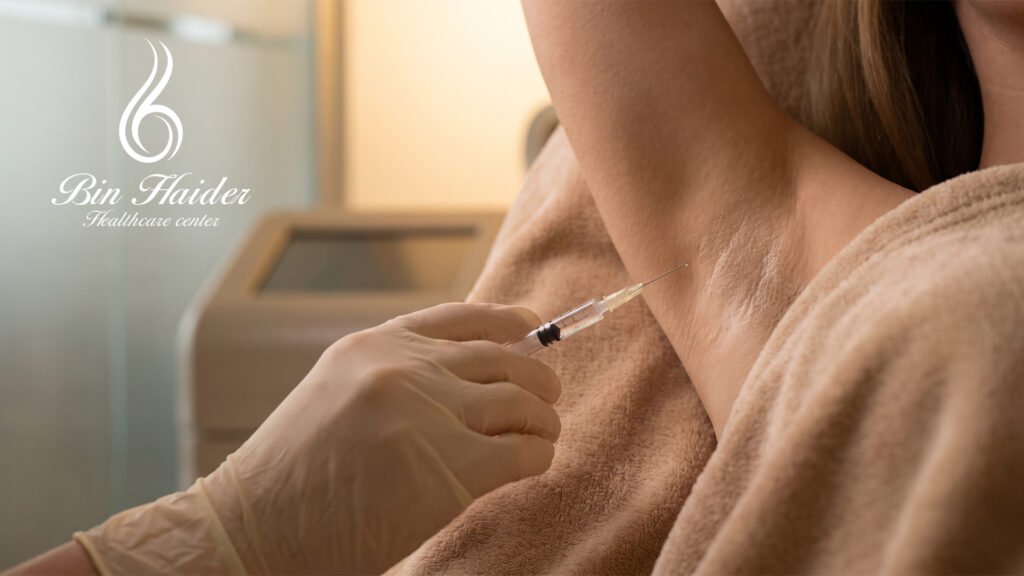
Botox (onabotulinumtoxinA) works by blocking the release of acetylcholine, the neurotransmitter responsible for activating the eccrine sweat glands. When injected into the underarm, it temporarily interrupts the nerve signal that tells these glands to produce sweat, significantly reducing perspiration in the treated area without affecting the body’s overall temperature regulation elsewhere.
Tip: Hyperhidrosis is a diagnosable medical condition, assessed with a specific severity scale, not simply “sweating a lot.” A proper diagnosis using this scale is part of a legitimate treatment pathway, not an optional formality.
Botox was FDA-approved for severe primary axillary hyperhidrosis in 2004, making it the first non-muscle indication approved for this molecule. It remains approved in at least 20 countries specifically for this use.
Hyperhidrosis Treatment: What the Clinical Data Shows
Here’s the actual clinical evidence behind this hyperhidrosis treatment, not general claims about effectiveness.
Pivotal FDA Trial Results
In the pivotal randomized, placebo-controlled trials that led to FDA approval, 50% to 55% of patients treated with onabotulinumtoxinA achieved an improvement of two or more points on the HDSS scale at 4 weeks, compared to just 6% of patients on placebo. This is a substantial, statistically meaningful difference that formed the basis of the treatment’s regulatory approval.
Long-Term Outcomes
Beyond the initial trials, longer-term data supports sustained benefit. A one-year prospective study of 81 patients found that sweat production dropped from 0.81 grams to 0.23 grams per 15 minutes, HDSS scores fell from 3.4 to 1.5, and quality-of-life scores (measured using the Dermatology Life Quality Index) improved from 19.9 to 6.9, all statistically significant improvements sustained across the full year of follow-up.
Tip: Ask what diagnostic method the clinic uses to map injection points. A starch-iodine test identifies the specific areas of most active sweating, which improves treatment precision compared to a generic, evenly spaced injection grid.
The Diagnostic Step Most Clinics Skip: The Starch-Iodine Test
A simple diagnostic step, often overlooked, meaningfully improves how precisely this hyperhidrosis treatment is targeted.
How the Test Works
Before injection, an iodine solution is applied to clean, dry underarm skin, followed by a thin layer of cornstarch. Areas with active sweating stain a distinctive dark blue-violet color within minutes, visually mapping exactly where the most active sweat glands are located.
Why Mapping Matters for Results
Injecting based on this mapped pattern, rather than a standard, evenly distributed grid, allows treatment to concentrate more precisely on the areas producing the most sweat. This targeted approach supports more consistent results than a one-size-fits-all injection pattern applied without any individual mapping.
Tip: This test takes only a few minutes but directly affects how precisely your treatment is targeted. It’s worth asking whether a clinic includes it as standard practice.
What to Expect: The Treatment Process
Knowing what happens at each stage makes the process feel far more predictable.
Consultation & Diagnosis
Every treatment plan begins with a consultation at BHHC’s Barsha Heights facility, where hyperhidrosis is formally assessed using the HDSS scale before any treatment is recommended. This diagnostic step confirms the condition and its severity, rather than treating based on a patient’s self-description alone.
The Injection Procedure
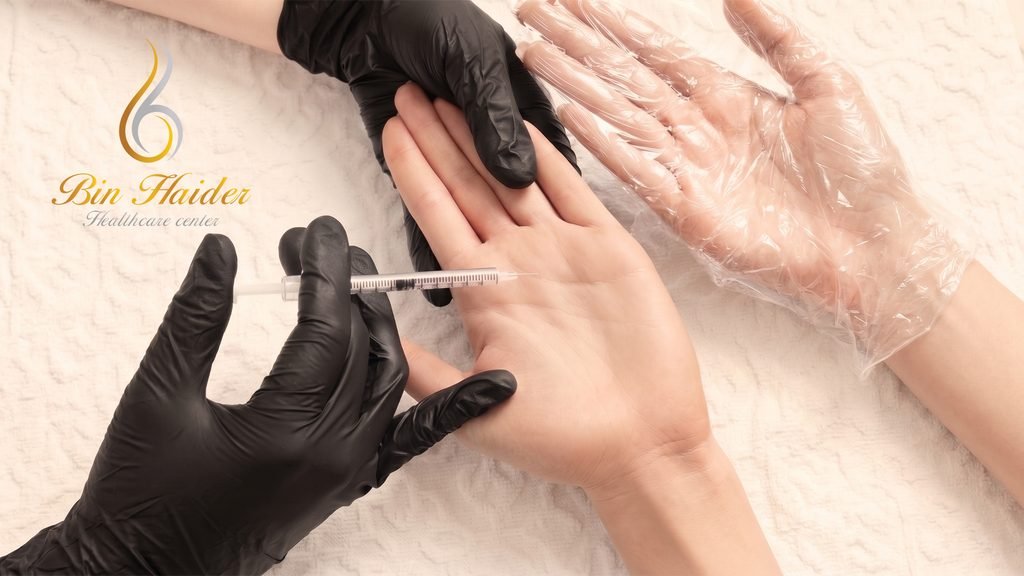
Following starch-iodine mapping, injections are administered in a grid pattern across the identified areas of active sweating. The entire procedure typically takes 15 to 20 minutes per session and doesn’t require general anesthesia. Topical numbing and cold compresses are commonly used to improve comfort.
Onset and Duration
Most patients notice a reduction in sweating within 2 to 7 days after treatment. Results typically last 4 to 6 months, with some patients experiencing relief for up to 9 months before a repeat session is needed.
Tip: Most patients resume normal activities immediately after treatment, though strenuous exercise should be avoided for 24 hours.
Our Facility & Technology Standards
Where a patient receives this treatment matters, since diagnostic accuracy and injection precision directly affect the outcome.
DHA Facility Licensing
DHA (Dubai Health Authority) facility licensing sets requirements for diagnostic protocols and staff credentialing across the entire clinical team, not just the individual physician a patient happens to see. A properly licensed facility maintains consistent diagnostic standards, including the use of validated assessment tools like the HDSS scale.
A Clinical Team Following Standardized Protocols
At BHHC, hyperhidrosis treatment is delivered by a clinical team operating under Dr. Hessa Bin Haider’s medical supervision and shared, facility-wide diagnostic and injection protocols, rather than depending on one individual practitioner’s personal method.
Tip: Ask any Dubai facility for their DHA license number. A properly licensed center will provide it without hesitation.
Sweating Botox in Dubai: What to Know
Understanding the science is one part of the picture; knowing what to look for in a Dubai facility for this specific medical indication is the practical next step.
Why DHA-Licensed Providers Matter for a Medical Indication Like This
Sweating Botox in Dubai should come from a DHA-licensed provider who treats hyperhidrosis as the diagnosable medical condition it is, using proper assessment tools like the HDSS scale and, ideally, starch-iodine mapping before treatment. This is a medical indication with FDA-approved trial data behind it, not a purely cosmetic add-on.
Cost Factors
Pricing for hyperhidrosis Botox treatment typically reflects the units required to treat both underarms and the facility’s diagnostic and clinical standards.
Tip: Ask whether the quoted price includes the diagnostic starch-iodine test, not just the injection itself, since this diagnostic step affects how precisely your treatment is targeted.
Why Choose Bin Haider Healthcare Center in Dubai
Choosing a properly licensed facility matters for a medical indication where diagnostic precision directly affects treatment outcomes.
Bin Haider Healthcare Center is a DHA-licensed dermatology and aesthetic facility located in Barsha Heights, Dubai, operating under the medical supervision of Dr. Hessa Bin Haider, a Board-Certified Dermatologist & Aesthetic Physician with over 20 years of experience. The clinic holds a 4.9/5 rating across 312 Google reviews.
What sets BHHC apart is a diagnostic-first approach, combining HDSS assessment and starch-iodine testing before treatment, alongside comprehensive dermatology services under one roof. The facility operates under consistent, facility-wide clinical standards rather than relying on a single practitioner alone.
Ready to book your consultation?
[Book a Consultation] → Contact us via WhatsApp or call +971 4 770 0600 to schedule your assessment at our Barsha Heights facility.
FAQs
How does Botox for excessive sweating work?
Botox blocks the release of acetylcholine, the neurotransmitter that activates sweat glands. When injected into the underarm, it temporarily interrupts the nerve signal that triggers excessive sweating, significantly reducing perspiration in the treated area without affecting the body’s overall temperature regulation.
How long does Botox for underarm sweating last?
Results typically last 4 to 6 months, with some patients experiencing relief for up to 9 months. Most patients notice reduced sweating within 2 to 7 days of treatment, and maintenance injections are recommended as the effect gradually diminishes over time.
Is Botox for hyperhidrosis painful?
Most patients experience minimal discomfort. Topical numbing and cold compresses are commonly used to improve comfort during the procedure, which typically takes 15 to 20 minutes and doesn’t require general anesthesia.
How is hyperhidrosis actually diagnosed before treatment?
Diagnosis typically uses the Hyperhidrosis Disease Severity Scale (HDSS), a 4-point scale assessing how much underarm sweating interferes with daily activities. A starch-iodine test may also be used to visually map the specific areas of most active sweating before injection.
Where can I get sweating Botox in Dubai?
Sweating Botox in Dubai should come from a DHA-licensed facility that treats hyperhidrosis as a diagnosable medical condition, using validated assessment tools like the HDSS scale rather than treating based on a patient’s description alone.
Is Botox for excessive sweating covered as a medical treatment or purely cosmetic?
It’s an FDA-approved medical indication, not a purely cosmetic use. Botox received FDA approval specifically for severe primary axillary hyperhidrosis in 2004, backed by pivotal clinical trial data, making it a recognized medical treatment for this diagnosable condition.
References
- International Hyperhidrosis Society — Botox for Hyperhidrosis: FDA Approval and Clinical Background
- NCBI/PMC (2024) — Assessing Botulinum Toxin Effectiveness and Quality of Life in Axillary Hyperhidrosis: A One-Year Prospective Study
- NCBI/PMC — Efficacy and Safety of Botulinum Toxin Type A in Primary Axillary Hyperhidrosis: A Meta-analysis and Systematic Review
- FDA — Botox Prescribing Label and Clinical Trial Data (Primary Axillary Hyperhidrosis)